Introduction Why Six Sigma
Discussion Outline Define Six Sigma Relate Sigma levels to everyday processes Introduce the 15 Deliverable Roadmap for Six Sigma projects List the attributes of a successful Black Belt Identify the Strategic Focus of JEA Identify the objectives of this training
Six Sigma Definition Six Sigma is a management philosophy that emphasizes setting extremely high objectives, collecting data, and analyzing results to a fine degree as a way to reduce defects in products and services.  The philosophy behind Six Sigma is to measure how many defects are in a process, then figure out how to systematically eliminate them and get as close to perfection as possible.  To achieve Six Sigma, a process cannot produce more than 3.4 defects per million opportunities, where an opportunity is defined as a chance for nonconformance.
Six Sigma Processes Six Sigma DMAIC is a process that  D efines,  M easures,  A nalyzes,  I mproves, and  C ontrols existing processes that fall below Six Sigma performance.  Six Sigma DMADV  D efines,  M easures,  A nalyzes,  D esigns, and  V erifies new processes or products that are intended to achieve Six Sigma level quality.  All Six Sigma processes are executed by Six Sigma Green Belts or Six Sigma Black Belts, which are then overseen by a Six Sigma Master Black Belt. These terms were created at Motorola.
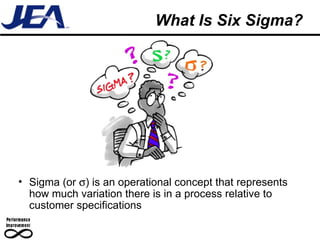
What Is Six Sigma? Sigma (or   ) is an operational concept that represents how much variation there is in a process relative to customer specifications
Imagine Two Lawns
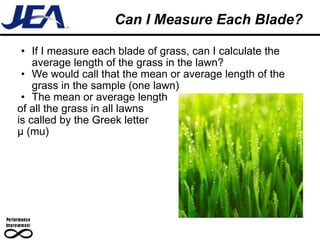
Can I Measure Each Blade? If I measure each blade of grass, can I calculate the average length of the grass in the lawn? We would call that the mean or average length of the grass in the sample (one lawn) The mean or average length of all the grass in all lawns  is called by the Greek letter μ (mu)
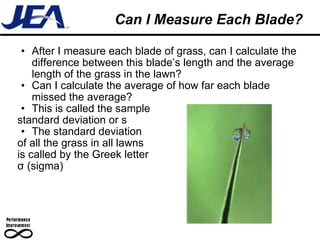
Can I Measure Each Blade? After I measure each blade of grass, can I calculate the difference between this blade’s length and the average length of the grass in the lawn? Can I calculate the average of how far each blade missed the average? This is called the sample  standard deviation or s The standard deviation of all the grass in all lawns  is called by the Greek letter σ (sigma)
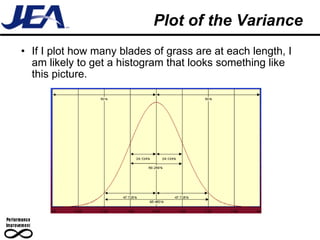
Plot of the Variance If I plot how many blades of grass are at each length, I am likely to get a histogram that looks something like this picture.
Customer Perception Threshold  When can I tell there is a difference in the length of the blades of grass as I drive by and look at the lawn from my moving car? When can I tell a difference in the length of the blades of grass if I am Tiger Woods putting to win a major championship? Each customer has a perception threshold and you must know what it is.
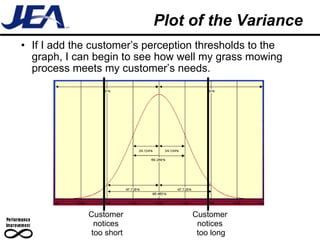
Plot of the Variance If I add the customer’s perception thresholds to the graph, I can begin to see how well my grass mowing process meets my customer’s needs. Customer  notices  too short Customer  notices  too long
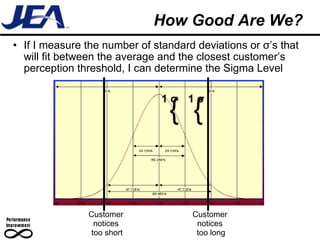
How Good Are We? If I measure the number of standard deviations or σ’s that will fit between the average and the closest customer’s perception threshold, I can determine the Sigma Level Customer  notices  too short Customer  notices  too long { { 1 σ 1 σ
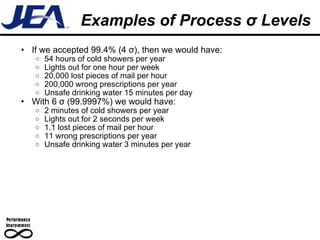
Examples of Process σ Levels If we accepted 99.4% (4 σ), then we would have: 54 hours of cold showers per year Lights out for one hour per week 20,000 lost pieces of mail per hour 200,000 wrong prescriptions per year Unsafe drinking water 15 minutes per day With 6 σ (99.9997%) we would have: 2 minutes of cold showers per year Lights out for 2 seconds per week 1.1 lost pieces of mail per hour 11 wrong prescriptions per year Unsafe drinking water 3 minutes per year
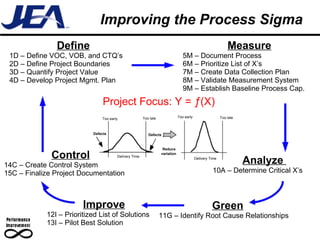
Improving the Process Sigma Define 1D – Define VOC, VOB, and CTQ’s 2D – Define Project Boundaries 3D – Quantify Project Value 4D – Develop Project Mgmt. Plan Measure 5M – Document Process 6M – Prioritize List of X’s 7M – Create Data Collection Plan 8M – Validate Measurement System 9M – Establish Baseline Process Cap. Analyze  10A – Determine Critical X’s Improve 12I – Prioritized List of Solutions 13I – Pilot Best Solution Control 14C – Create Control System 15C – Finalize Project Documentation Green 11G – Identify Root Cause Relationships Project Focus: Y = ƒ(X) Defects Defects Too early Too late Delivery Time Reduce  variation Delivery Time Too early Too late
A Successful Black Belt Implements changes effectively Coaches and develops team members Communicates effectively in multiple channels Follows a defined problem solving methodology Does not skip steps, does not jump to conclusions Demonstrates a continuous, logical flow in improvement work Meets objectives and timelines
Process Improvement at JEA  Process Improvement Green Belt DMAGIC Projects Green Belt Lean Projects Black Belt DMAGIC Projects Black Belt Lean Projects Training in common problem-solving approaches and vocabulary Yellow Belt Green Belt Black Belt New Process Development and Deployment DMADV / DFSS
Process Improvement Roles Champion Sponsor projects and remove barriers Yellow Belts Work on project teams and help deploy improvements Green Belts Execute projects that can be resolved without crossing Officer-level lines of responsibility Black Belts Execute projects as assigned. Typically, more complex and cross-functional than Green Belt projects.  Master Black Belt Support everyone with review and input to assure valid methods are used Provide certification
A Balanced Organization Jim Dickenson, James Chansler and Paul McElroy, with the input of others, developed four main areas that need to be balanced for a successful JEA Financial Performance Customer Expectations Organizational Effectiveness Community Responsibility
Financial Performance Do we manage money responsibly, meet budgets and have the right level of debt? Focus Areas Liquidity:  Maintain cash and cash equivalent levels that allow us to take advantage of market opportunities, withstand negative catastrophic events, and create strong credit ratings Debt Management:  Manage JEA’s debt with an overall philosophy of achieving the lowest possible interest cost, minimizing the amount of debt outstanding and protecting the bondholder with strong levels of debt service coverage Net Revenue:  (Revenues – Operating Expenses) Earn sufficient levels of net revenue to allow us to re-invest in our business, cover our debt service obligations, meet Rating Agency expectations and pay an appropriate city contribution.
Customer Expectations Do we meet our customers expectations in regards to cost, quality and customer service? Focus Areas Customer Service:  Treat customers with respect, endeavor to meet their expectations and continually improve service levels Price:  Maintain a price structure that will ensure adequate income growth, provide high quality services, maintain fiscal responsibility and be competitive with benchmarked peers Quality:  Keep the electricity on, the water clean and pressurized, wastewater efficiently removed without cave-ins, blockages or odors.
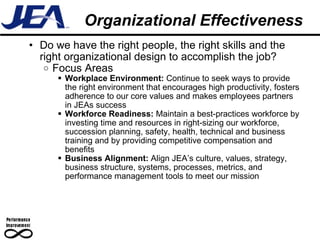
Organizational Effectiveness Do we have the right people, the right skills and the right organizational design to accomplish the job? Focus Areas Workplace Environment:  Continue to seek ways to provide the right environment that encourages high productivity, fosters adherence to our core values and makes employees partners in JEAs success Workforce Readiness:  Maintain a best-practices workforce by investing time and resources in right-sizing our workforce, succession planning, safety, health, technical and business training and by providing competitive compensation and benefits Business Alignment:  Align JEA’s culture, values, strategy, business structure, systems, processes, metrics, and performance management tools to meet our mission
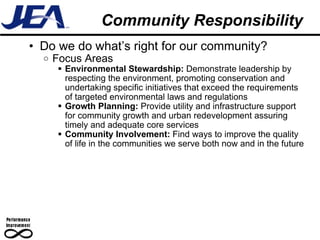
Community Responsibility Do we do what’s right for our community? Focus Areas Environmental Stewardship:  Demonstrate leadership by respecting the environment, promoting conservation and undertaking specific initiatives that exceed the requirements of targeted environmental laws and regulations Growth Planning:  Provide utility and infrastructure support for community growth and urban redevelopment assuring timely and adequate core services Community Involvement:  Find ways to improve the quality of life in the communities we serve both now and in the future
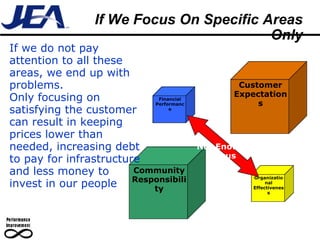
If We Focus On Specific Areas Only Financial Performance Community Responsibility Customer Expectations Organizational Effectiveness Not Enough Focus If we do not pay attention to all these areas, we end up with problems.  Only focusing on satisfying the customer can result in keeping prices lower than needed, increasing debt to pay for infrastructure and less money to invest in our people
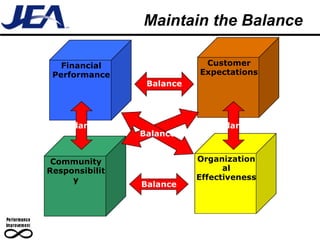
Maintain the Balance Financial Performance Community Responsibility Customer Expectations Organizational Effectiveness Balance Balance Balance Balance Balance
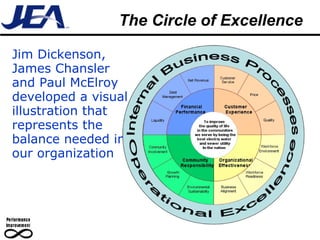
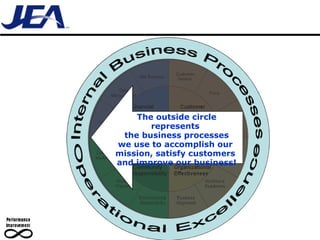
The Circle of Excellence Jim Dickenson, James Chansler and Paul McElroy developed a visual illustration that represents the balance needed in our organization
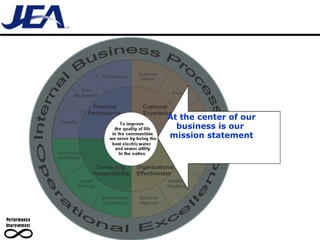
At the center of our business is our  mission statement
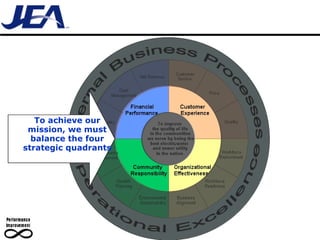
To achieve our mission, we must balance the four strategic quadrants
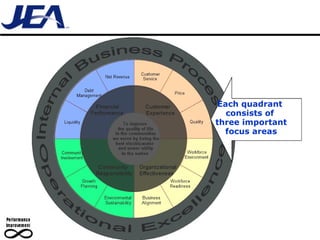
Each quadrant  consists of  three important focus areas
The outside circle represents  the business processes we use to accomplish our  mission, satisfy customers  and improve our business!
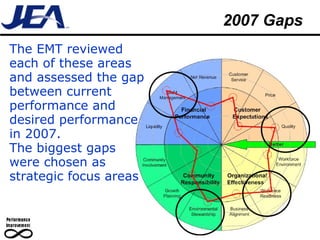
2007 Gaps 30   The EMT reviewed each of these areas and assessed the gap between current performance and desired performance in 2007.  The biggest gaps were chosen as strategic focus areas
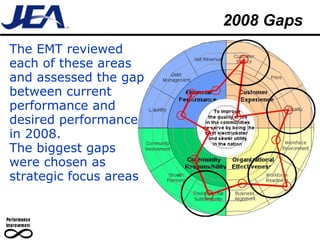
2008 Gaps The EMT reviewed each of these areas and assessed the gap between current performance and desired performance in 2008.  The biggest gaps were chosen as strategic focus areas
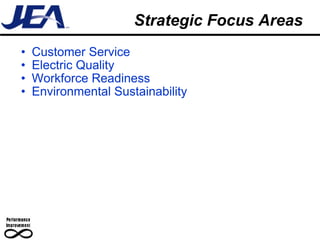
Strategic Focus Areas Customer Service Electric Quality Workforce Readiness Environmental Sustainability
Customer Service Description:  Customer Service is measured by direct customer surveys from three sources: American Customer Service Index (ACSI) MSI Model Customer Recontact Survey Goal:  Improve ACSI score from 76 to 77. Why:  Customer Satisfaction around service (their perception) is and remains a significant part of JEA’s mission and strategic plan; and JEA currently has a large negative gap in this area. We constantly need to provide a visible and positive value to our customers.
Electric Quality  (SAIDI, SAIFI, SAIRFI) Description:  JEA customers consistently rank us low and think we’re providing unreliable electric services—and some internal metrics match that assessment. Goal:  The percent 9s and 10s metric on the electric reliability question from our customer survey is greater than 60% for residential customers and greater than 65% for commercial. Internal metrics (SAIFI, SAIFI-2, SARFI-80) are improved by at least 50%. Why:  Customer Satisfaction around Quality (their perception) is and remains a significant part of JEA’s mission and strategic plan; and JEA currently has a large negative gap in this area. NERC Electric Reliability Standards are driving us in that direction. JEA needs to step out front and be seen as an industry leader (vs. being forced along). We constantly need to provide a visible and positive increase in value to our customers.
Workforce Readiness (Right Talent, Right Time, Right Place) Description:  Ensuring we have the workforce that we need both now and in the future Goal:  Develop and execute a plan to have a workforce that meets our current and future needs Why:  Like most utilities, JEA is currently experiencing difficulty hiring qualified employees in certain positions. Recruiting and retaining quality employees will become more difficult in the future. JEA needs to plan and act on this issue now.
Environmental Sustainability (Meeting Future Requirements) Description:  No consistent environmental policy/strategy utilized in planning for future growth across company. Goal:  Environmental goals and plans are based on a philosophy of sustainability. At JEA, Environmental Sustainability means – a consideration of economic, environmental and social equity factors in all major decisions, but specifically as it relates to managing community growth. Why:  We are moving toward a world in which resource use, emissions and discharge expectations are dramatically changing. Some communities in the U.S are already experiencing escalating requirements such as south Florida’s water constraints. There are also active discussions around limiting carbon dioxide (CO 2 ) emissions, zero wastewater discharge and many other restrictions which could dramatically impact JEA.
What does this mean for me? Even though many employees in the company will be focused on these four strategic initiatives, not all employees will be involved We still need to ‘get the work done’ throughout the company (balanced focus) Continue to focus on what you are responsible for Once the strategic plans are developed, be aware of the plans and understand how your actions impact them Participate on teams when requested
Training Goals This course will  Provide you with a 15 deliverable roadmap to solving problems within the DMAGIC methodology Improving processes that operate on a routine basis Introduce you to Black Belt Six Sigma tools Individual tools are also used outside the DMAGIC methodology to address various needs in day to day work Help you become a leader for Process Improvement projects
Learning Check You should now be able to: Define Six Sigma Relate Sigma levels to everyday processes Introduce the 15 Deliverable Roadmap for Six Sigma projects List the attributes of a successful Black Belt Identify the Strategic Focus of JEA Identify the objectives of this training

D04 Why6Sigma

  • 1.
  • 2.
    Discussion Outline DefineSix Sigma Relate Sigma levels to everyday processes Introduce the 15 Deliverable Roadmap for Six Sigma projects List the attributes of a successful Black Belt Identify the Strategic Focus of JEA Identify the objectives of this training
  • 3.
    Six Sigma DefinitionSix Sigma is a management philosophy that emphasizes setting extremely high objectives, collecting data, and analyzing results to a fine degree as a way to reduce defects in products and services. The philosophy behind Six Sigma is to measure how many defects are in a process, then figure out how to systematically eliminate them and get as close to perfection as possible. To achieve Six Sigma, a process cannot produce more than 3.4 defects per million opportunities, where an opportunity is defined as a chance for nonconformance.
  • 4.
    Six Sigma ProcessesSix Sigma DMAIC is a process that D efines, M easures, A nalyzes, I mproves, and C ontrols existing processes that fall below Six Sigma performance. Six Sigma DMADV D efines, M easures, A nalyzes, D esigns, and V erifies new processes or products that are intended to achieve Six Sigma level quality. All Six Sigma processes are executed by Six Sigma Green Belts or Six Sigma Black Belts, which are then overseen by a Six Sigma Master Black Belt. These terms were created at Motorola.
  • 5.
    What Is SixSigma? Sigma (or  ) is an operational concept that represents how much variation there is in a process relative to customer specifications
  • 6.
  • 7.
    Can I MeasureEach Blade? If I measure each blade of grass, can I calculate the average length of the grass in the lawn? We would call that the mean or average length of the grass in the sample (one lawn) The mean or average length of all the grass in all lawns is called by the Greek letter μ (mu)
  • 8.
    Can I MeasureEach Blade? After I measure each blade of grass, can I calculate the difference between this blade’s length and the average length of the grass in the lawn? Can I calculate the average of how far each blade missed the average? This is called the sample standard deviation or s The standard deviation of all the grass in all lawns is called by the Greek letter σ (sigma)
  • 9.
    Plot of theVariance If I plot how many blades of grass are at each length, I am likely to get a histogram that looks something like this picture.
  • 10.
    Customer Perception Threshold When can I tell there is a difference in the length of the blades of grass as I drive by and look at the lawn from my moving car? When can I tell a difference in the length of the blades of grass if I am Tiger Woods putting to win a major championship? Each customer has a perception threshold and you must know what it is.
  • 11.
    Plot of theVariance If I add the customer’s perception thresholds to the graph, I can begin to see how well my grass mowing process meets my customer’s needs. Customer notices too short Customer notices too long
  • 12.
    How Good AreWe? If I measure the number of standard deviations or σ’s that will fit between the average and the closest customer’s perception threshold, I can determine the Sigma Level Customer notices too short Customer notices too long { { 1 σ 1 σ
  • 13.
    Examples of Processσ Levels If we accepted 99.4% (4 σ), then we would have: 54 hours of cold showers per year Lights out for one hour per week 20,000 lost pieces of mail per hour 200,000 wrong prescriptions per year Unsafe drinking water 15 minutes per day With 6 σ (99.9997%) we would have: 2 minutes of cold showers per year Lights out for 2 seconds per week 1.1 lost pieces of mail per hour 11 wrong prescriptions per year Unsafe drinking water 3 minutes per year
  • 14.
    Improving the ProcessSigma Define 1D – Define VOC, VOB, and CTQ’s 2D – Define Project Boundaries 3D – Quantify Project Value 4D – Develop Project Mgmt. Plan Measure 5M – Document Process 6M – Prioritize List of X’s 7M – Create Data Collection Plan 8M – Validate Measurement System 9M – Establish Baseline Process Cap. Analyze 10A – Determine Critical X’s Improve 12I – Prioritized List of Solutions 13I – Pilot Best Solution Control 14C – Create Control System 15C – Finalize Project Documentation Green 11G – Identify Root Cause Relationships Project Focus: Y = ƒ(X) Defects Defects Too early Too late Delivery Time Reduce variation Delivery Time Too early Too late
  • 15.
    A Successful BlackBelt Implements changes effectively Coaches and develops team members Communicates effectively in multiple channels Follows a defined problem solving methodology Does not skip steps, does not jump to conclusions Demonstrates a continuous, logical flow in improvement work Meets objectives and timelines
  • 16.
    Process Improvement atJEA Process Improvement Green Belt DMAGIC Projects Green Belt Lean Projects Black Belt DMAGIC Projects Black Belt Lean Projects Training in common problem-solving approaches and vocabulary Yellow Belt Green Belt Black Belt New Process Development and Deployment DMADV / DFSS
  • 17.
    Process Improvement RolesChampion Sponsor projects and remove barriers Yellow Belts Work on project teams and help deploy improvements Green Belts Execute projects that can be resolved without crossing Officer-level lines of responsibility Black Belts Execute projects as assigned. Typically, more complex and cross-functional than Green Belt projects. Master Black Belt Support everyone with review and input to assure valid methods are used Provide certification
  • 18.
    A Balanced OrganizationJim Dickenson, James Chansler and Paul McElroy, with the input of others, developed four main areas that need to be balanced for a successful JEA Financial Performance Customer Expectations Organizational Effectiveness Community Responsibility
  • 19.
    Financial Performance Dowe manage money responsibly, meet budgets and have the right level of debt? Focus Areas Liquidity: Maintain cash and cash equivalent levels that allow us to take advantage of market opportunities, withstand negative catastrophic events, and create strong credit ratings Debt Management: Manage JEA’s debt with an overall philosophy of achieving the lowest possible interest cost, minimizing the amount of debt outstanding and protecting the bondholder with strong levels of debt service coverage Net Revenue: (Revenues – Operating Expenses) Earn sufficient levels of net revenue to allow us to re-invest in our business, cover our debt service obligations, meet Rating Agency expectations and pay an appropriate city contribution.
  • 20.
    Customer Expectations Dowe meet our customers expectations in regards to cost, quality and customer service? Focus Areas Customer Service: Treat customers with respect, endeavor to meet their expectations and continually improve service levels Price: Maintain a price structure that will ensure adequate income growth, provide high quality services, maintain fiscal responsibility and be competitive with benchmarked peers Quality: Keep the electricity on, the water clean and pressurized, wastewater efficiently removed without cave-ins, blockages or odors.
  • 21.
    Organizational Effectiveness Dowe have the right people, the right skills and the right organizational design to accomplish the job? Focus Areas Workplace Environment: Continue to seek ways to provide the right environment that encourages high productivity, fosters adherence to our core values and makes employees partners in JEAs success Workforce Readiness: Maintain a best-practices workforce by investing time and resources in right-sizing our workforce, succession planning, safety, health, technical and business training and by providing competitive compensation and benefits Business Alignment: Align JEA’s culture, values, strategy, business structure, systems, processes, metrics, and performance management tools to meet our mission
  • 22.
    Community Responsibility Dowe do what’s right for our community? Focus Areas Environmental Stewardship: Demonstrate leadership by respecting the environment, promoting conservation and undertaking specific initiatives that exceed the requirements of targeted environmental laws and regulations Growth Planning: Provide utility and infrastructure support for community growth and urban redevelopment assuring timely and adequate core services Community Involvement: Find ways to improve the quality of life in the communities we serve both now and in the future
  • 23.
    If We FocusOn Specific Areas Only Financial Performance Community Responsibility Customer Expectations Organizational Effectiveness Not Enough Focus If we do not pay attention to all these areas, we end up with problems. Only focusing on satisfying the customer can result in keeping prices lower than needed, increasing debt to pay for infrastructure and less money to invest in our people
  • 24.
    Maintain the BalanceFinancial Performance Community Responsibility Customer Expectations Organizational Effectiveness Balance Balance Balance Balance Balance
  • 25.
    The Circle ofExcellence Jim Dickenson, James Chansler and Paul McElroy developed a visual illustration that represents the balance needed in our organization
  • 26.
    At the centerof our business is our mission statement
  • 27.
    To achieve ourmission, we must balance the four strategic quadrants
  • 28.
    Each quadrant consists of three important focus areas
  • 29.
    The outside circlerepresents the business processes we use to accomplish our mission, satisfy customers and improve our business!
  • 30.
    2007 Gaps 30 The EMT reviewed each of these areas and assessed the gap between current performance and desired performance in 2007. The biggest gaps were chosen as strategic focus areas
  • 31.
    2008 Gaps TheEMT reviewed each of these areas and assessed the gap between current performance and desired performance in 2008. The biggest gaps were chosen as strategic focus areas
  • 32.
    Strategic Focus AreasCustomer Service Electric Quality Workforce Readiness Environmental Sustainability
  • 33.
    Customer Service Description: Customer Service is measured by direct customer surveys from three sources: American Customer Service Index (ACSI) MSI Model Customer Recontact Survey Goal: Improve ACSI score from 76 to 77. Why: Customer Satisfaction around service (their perception) is and remains a significant part of JEA’s mission and strategic plan; and JEA currently has a large negative gap in this area. We constantly need to provide a visible and positive value to our customers.
  • 34.
    Electric Quality (SAIDI, SAIFI, SAIRFI) Description: JEA customers consistently rank us low and think we’re providing unreliable electric services—and some internal metrics match that assessment. Goal: The percent 9s and 10s metric on the electric reliability question from our customer survey is greater than 60% for residential customers and greater than 65% for commercial. Internal metrics (SAIFI, SAIFI-2, SARFI-80) are improved by at least 50%. Why: Customer Satisfaction around Quality (their perception) is and remains a significant part of JEA’s mission and strategic plan; and JEA currently has a large negative gap in this area. NERC Electric Reliability Standards are driving us in that direction. JEA needs to step out front and be seen as an industry leader (vs. being forced along). We constantly need to provide a visible and positive increase in value to our customers.
  • 35.
    Workforce Readiness (RightTalent, Right Time, Right Place) Description: Ensuring we have the workforce that we need both now and in the future Goal: Develop and execute a plan to have a workforce that meets our current and future needs Why: Like most utilities, JEA is currently experiencing difficulty hiring qualified employees in certain positions. Recruiting and retaining quality employees will become more difficult in the future. JEA needs to plan and act on this issue now.
  • 36.
    Environmental Sustainability (MeetingFuture Requirements) Description: No consistent environmental policy/strategy utilized in planning for future growth across company. Goal: Environmental goals and plans are based on a philosophy of sustainability. At JEA, Environmental Sustainability means – a consideration of economic, environmental and social equity factors in all major decisions, but specifically as it relates to managing community growth. Why: We are moving toward a world in which resource use, emissions and discharge expectations are dramatically changing. Some communities in the U.S are already experiencing escalating requirements such as south Florida’s water constraints. There are also active discussions around limiting carbon dioxide (CO 2 ) emissions, zero wastewater discharge and many other restrictions which could dramatically impact JEA.
  • 37.
    What does thismean for me? Even though many employees in the company will be focused on these four strategic initiatives, not all employees will be involved We still need to ‘get the work done’ throughout the company (balanced focus) Continue to focus on what you are responsible for Once the strategic plans are developed, be aware of the plans and understand how your actions impact them Participate on teams when requested
  • 38.
    Training Goals Thiscourse will Provide you with a 15 deliverable roadmap to solving problems within the DMAGIC methodology Improving processes that operate on a routine basis Introduce you to Black Belt Six Sigma tools Individual tools are also used outside the DMAGIC methodology to address various needs in day to day work Help you become a leader for Process Improvement projects
  • 39.
    Learning Check Youshould now be able to: Define Six Sigma Relate Sigma levels to everyday processes Introduce the 15 Deliverable Roadmap for Six Sigma projects List the attributes of a successful Black Belt Identify the Strategic Focus of JEA Identify the objectives of this training